Two security stories broke this week, and they share one lesson worth a few minutes of your time: attackers are getting faster, and they are coming in through the tools and vendors businesses already trust.
The Short Version
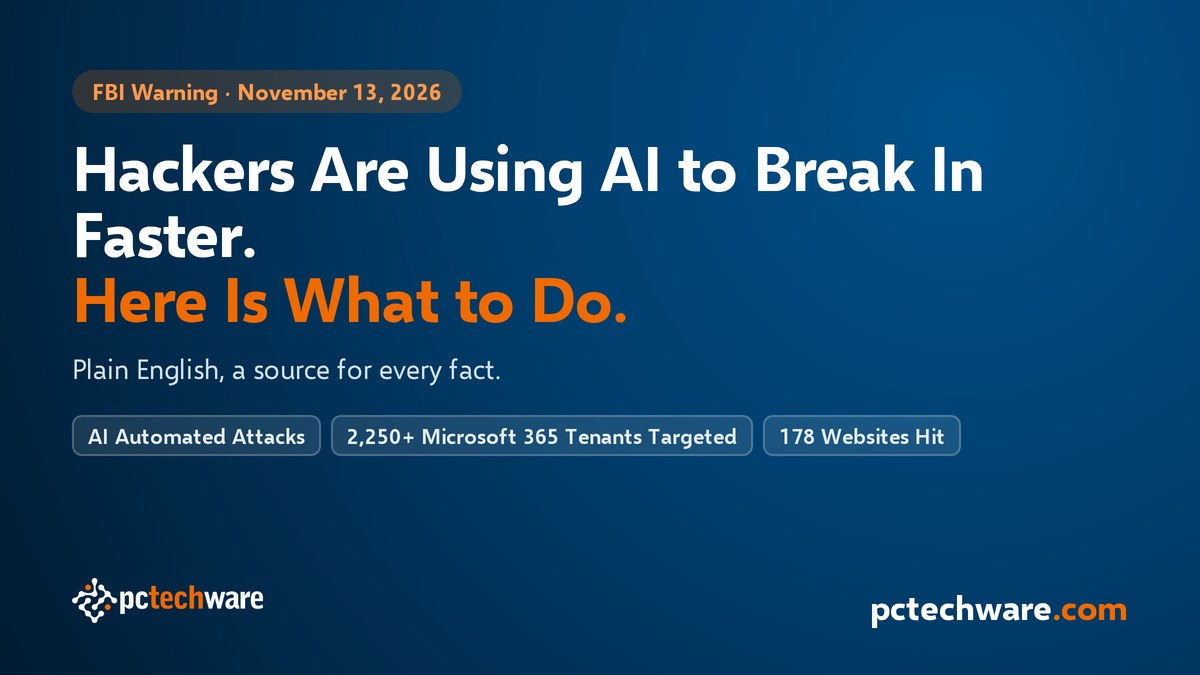
- The FBI warned on November 13 that criminals are using an AI tool called ARTEX to automate break-ins, in some cases reaching administrator level access in under three hours. [1]
- One campaign abused a trusted backup app to attempt sign-ins to more than 2,250 Microsoft 365 environments. [1][2]
- Separately, a compromised web service served card stealing code to visitors of 178 organizations, including Zoom, the BBC, CNN, Salesforce and Paychex, on November 16. [5]
What the FBI Is Warning About
ARTEX is an open source tool that was built for legitimate security testing. It connects to outside AI models and turns plain English goals into hacking steps that AI agents carry out on their own, from scouting a target to stealing data. [1] The FBI says criminals have used it since at least August 2026 against financial, government, healthcare, manufacturing, legal and other organizations around the world. [1]
Three points from the FBI's warning stand out for business owners. First, speed: some intrusions went from first contact to privileged access in under three hours. [1] Second, skill: the FBI says the tool lets attackers with minimal technical expertise run complex campaigns against many targets at once. [1] Third, it is not going away. The original developer pulled the code from GitHub in October, but copies, spinoffs and a paid version are still circulating, and researchers found more than 1,600 ARTEX control panels exposed on the internet in early November. [1]
The FBI also notes that ARTEX is especially good at finding the systems that get less attention: partner and supplier portals, older services, employee apps and third party integrations. [1]
The Trusted App Problem
The biggest example in the FBI's warning involves ConnectWise Cloud Backup, a Microsoft 365 backup service formerly known as SkyKick. [3] Microsoft says a China state aligned group it calls Storm-0940 was responsible. Instead of tricking employees into giving up passwords, the attackers abused the backup app's existing permission to connect to customers' Microsoft 365 environments, so no user ever had to sign in. [2] The FBI says that led to attempted sign-ins to more than 2,250 downstream Microsoft 365 environments. [1]
Two fair points belong next to that number. Microsoft says an attempted sign-in, or even a successful one, does not necessarily mean data was taken. [2] And ConnectWise told TechCrunch it cannot confirm the number of affected environments. [4] ConnectWise shut off the affected app connections on October 17 and has published steps for checking each environment. [3]
The lesson is bigger than one vendor. Every app you have ever connected to Microsoft 365, Google Workspace or your accounting system keeps its access until someone removes it, even if you stopped using it years ago. That access is a door, and attackers now have tools that check every door quickly.
The Optimizely Website Attack
The second story shows the same idea from the visitor's side. Optimizely is a service large websites use to test different versions of their pages. On November 16, an attacker slipped malicious code into the scripts Optimizely delivers to its customers' sites. Because the code came from Optimizely's real servers, the affected websites had no reason to block it. [5]
Report URI, the security firm that found it, counted 178 affected organizations, including Zoom, the BBC, CNN, Salesforce, IKEA, HSBC, Equifax and Paychex. [5] The code swapped cryptocurrency wallet addresses for the attacker's, captured card numbers typed into some checkout forms, stole cookies and screenshots, and tried to load exploit kits on older iPhones and iPads. [5] Report URI traced about 7,000 dollars in stolen cryptocurrency and says it cannot see how many card numbers were taken. [5]
Optimizely says the vulnerable path is blocked, the injected code was removed, and customers have been contacted directly. [6] Report URI found the code in only 1 of the 188 infected scripts by the evening of November 16. [5]
What We Recommend
For your business:
- Review the apps connected to Microsoft 365. Remove anything you no longer use, and question anything with broad permissions. The FBI specifically recommends least privilege for third party app permissions. [1]
- Watch for the warning signs. New app credentials, new administrator roles and sign-ins from unfamiliar places should raise an alert the same day, not show up in a review next month. [1]
- Keep the basics strong. Multifactor authentication on every account, conditional access for administrators, and backups that are tested and kept separate from your main systems.
- Know your vendors. Make a short list of every outside service that can reach your data. ARTEX targets exactly those connections. [1]
For you and your team at home:
- Check your card statements. If you made a purchase on one of the affected sites on November 16, watch for charges you do not recognize. Cards entered in a separate payment window, such as Stripe or Adyen, were out of the code's reach. [5]
- Update iPhones and iPads. Report URI says the exploit kit's own notes show iOS 18.7.3 and later, and 26.3 and later, are patched. [5] Settings, then General, then Software Update.
- Double check crypto addresses before sending any payment, and confirm with the recipient another way if anything looks off.
If you think something suspicious happened, the FBI asks that it be reported to your local field office or at ic3.gov. [1]
The Bottom Line
AI has not invented new ways to break in. It has made the old ones much faster. That puts the advantage back with businesses that know what is connected to their systems and notice changes quickly. If you would like a second set of eyes on the apps and vendors connected to your business, talk with our team.
Sources
- FBI FLASH-20261113-001, Threat Overview of ARTEX Autonomous Penetration Testing Framework, November 13, 2026. www.ic3.gov
- Microsoft Security Blog, AI-driven, large-scale nation-state campaign using ARTEX enables supply chain compromise, October 21, 2026. www.microsoft.com
- ConnectWise, Cloud Backup technical investigation and remediation guide. www.connectwise.com
- TechCrunch, FBI says Artex AI open source hacking tool used to breach networks in under three hours, November 16, 2026. techcrunch.com
- Report URI, World's Largest Brands Infected With Malware Via Optimizely, November 16, 2026. blog.report-uri.com
- The Record, Website management platform Optimizely confirms hackers put malicious code into customer sites, November 17, 2026. therecord.media

Russell leads PC Techware and its cybersecurity and compliance practice, including CMMC and NIST readiness.
Connect on LinkedIn